

Discover Pesaro

Plan Your Trip

The Lordships of Pesaro
The history of Pesaro is rich, filled with fascinating events whose protagonists were among the most famous and influential figures in all of Italy at the time. The Renaissance marks the era of the Lordships of Pesaro, whose leading families were: the Malatesta (1285–1445), the Sforza (1445–1512), whose rule was interrupted by Cesare Borgia from 1500 to 1503, and later restored by Pope Julius II, who entrusted it to the Della Rovere (1513–1631).
The power of the Malatesta reached Pesaro between the late 13th and early 14th centuries, around 1285, spreading also to nearby Cervia, Iesi, Osimo, Senigallia, and Ascoli. Fano, however, was annexed only in 1340 after several attempts by the Malatesta to acquire it from Guido di Carignano, who eventually ceded it. The entire Marche of Ancona became part of the lordship between 1348 and 1350. Notable among the successors of the first Malatesta was Malatestino, nicknamed “dall’Occhio” (of the Eye) for his blind eye, whom Dante calls Mastin Nuovo. He was Lord and Captain of Rimini, fought against the Ghibelline Malatestino of Sogliano with the support of King Robert of Naples, and opposed Emperor Henry VII of Luxembourg. Even more famous is Giovanni lo Zoppo, known as Gianciotto Malatesta, Podestà of Faenza, Lord of Pesaro, and, above all, the protagonist of one of the most famous cantos of Dante’s Divine Comedy: Canto V of the Inferno. He is known for the murder of his wife, Francesca da Polenta, which he committed in Gradara Castle due to her alleged betrayal.
The Malatesta promoted important works of art in Pesaro, such as the portal of the Church of Sant’Agostino and the restoration of the former Church of San Francesco, significantly enhancing the city’s appearance. Modifications to the Ducal Palace were minimal, as it underwent radical changes under the subsequent lordship of the Sforza. Alessandro Sforza, who took control of Pesaro in 1445, carried out extensive modernization of the Ducal Palace, adding luxurious spaces such as the Salone Metaurense, which hosted the 1465 wedding ceremony of his son Costanzo with Camilla d’Aragona. Between 1478 and 1483, Costanzo commissioned the Rocca Costanza, which was seized by Cesare Borgia, the Duke Valentino, in 1500, and later reclaimed by the Sforza in 1503.
In 1513, Pope Julius II entrusted the lordship of Pesaro to his nephew Francesco Maria I della Rovere, already Duke of Urbino. The Della Rovere commissioned several new monuments that left a lasting mark on Pesaro, including the pentagonal city walls and further expansions of the Ducal Palace. The Villa Imperiale was also renovated, and by the will of Guidobaldo II, the magnificent Church of San Giovanni Battista was erected. Guidobaldo II ruled Pesaro until 1574, succeeded by the last of the Della Rovere, Francesco Maria II.
See also

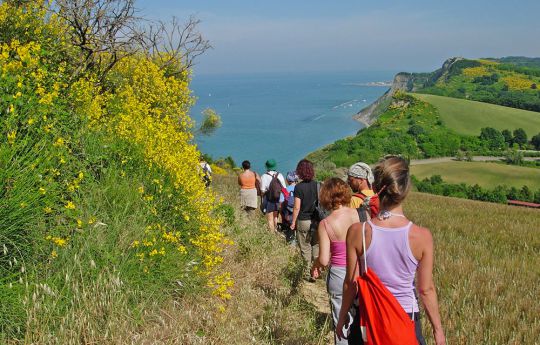
Trekking on San Bartolo
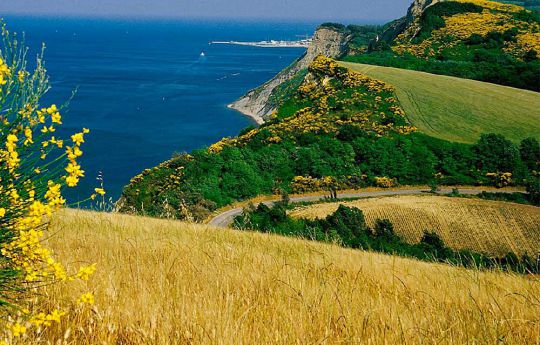
Sea views, wild beaches, and Mediterranean scrub. Route: 4.5 km,…
Discover more


Shopping and Wellness
Tipico.tips-Local gems from Marche The Welcome Pesaro Card gives you…
Discover more


Museums and Monuments
Card Pesaro Capitale DISCOUNTED FOR ALL WELCOME PESARO CARD HOLDERS…
Discover more